
Augustine versus the Ugly City
The ugliness of the modern Western city is not a failure of imagination or budget — it is a success of ideology, and Saint Augustine saw the whole thing coming.

Buildings are frozen loves. They teach every child, hourly and wordlessly, what the world thinks she is worth. Get the buildings wrong and you are running a catechism of meaninglessness that no one can refuse to attend.
Here is the argument, at walking pace.
Start with the spray paint
Augustine’s most powerful idea sounds abstract until you point it at a wall. Evil, he argued, has no existence of its own. It is privatio boni — a parasite on the good. Rust needs iron. Rot needs wood. A lie only works because language was made for truth.
Graffiti is that theory in aerosol. It cannot exist on nothing; there has never been graffiti in an open field. The tag creates no surface and commands no space — its entire mode of being is trespass, dominion asserted over a surface when dominion over substance is out of reach.
But watch where it spreads. Graffiti metastasizes on faceless buildings — the blank flank of the big-box store, the concrete haunch of the overpass — and largely skips the carved doorway. A wall that shows human care makes a claim: someone made this, for you. Even the vandal hesitates before a face. The blank wall makes no claim at all, and the tag is simply the first answer to a question the architecture asked.
The bottom line: the tag is a parasite, and the faceless wall is the perfect host. A city covered in graffiti is a city whose buildings stopped speaking first. So the real question is not who holds the spray can. It is who built the blankness — and why.
Name the villain
Call it the Doctrine of Ugliness: the creed, nowhere printed and everywhere obeyed, that matter has no dignity, that inherited form is superstition, that human scale is a sentimentality, and that the built world is raw stock for the correct order imposed from above. It is the old Gnostic contempt for creation, back with a clipboard.
Augustine knew the type from the inside. He spent nine years in a sect with a total system, scientific pretensions, and unfalsifiable confidence — and watched its predictions fail while its certainty never wavered. Swap the master plan for the star-charts and the psychology repeats exactly: pride wearing the costume of reason.
To be fair: the modern planners were not villains twirling compasses. They had walked real slums — the lightless court, the consumptive child, cholera in the water — and against that darkness they prescribed light, air, and the clean rational surface. There was genuine charity in it. Augustine’s reply is surgical: they diagnosed a real privation and prescribed a greater one. The slum withheld light from the body. The tower withheld address from the soul.
The American proof, 1958: Boston declared its West End blighted — forty-six acres, some seven thousand residents, functioning streets, dense kinship, low crime, none of which mattered. The neighborhood was razed for luxury towers, and the developers hung a sign over the highway that reads today like an accidental confession: If you lived here, you’d be home now. The displaced grieved clinically, with the symptoms of bereavement, for years — because a neighborhood of the old kind is not housing stock; it is an extension of the body. Fourteen years later, St. Louis dynamited the doctrine’s award-winning masterpiece on live television. Concrete spalls. Theories spall faster.
The law the doctrine repealed
Augustine’s aesthetics rests on four rules. They fit in a pocket, and they condemn a century.
Rule one: beauty is number. Proportion is real, not preference. God disposed all things “in measure and number and weight,” and when you stand before a proportioned façade and feel something you cannot articulate, you are not projecting — you are recognizing, in stone, the same ratios that structure your heartbeat and your breath. The refutation of relativism stands in every old town in Europe, where every eye, from every century, votes with its feet for the same streets. The modern styles broke this law three ways: brutalism deleted the number, the socialist plan deleted the man the number was scaled to, and postmodernism kept the number’s corpse and taught it to wink.
Rule two: number is not enough — beauty is alive. This is Augustine correcting his younger self, and it is the sharpest edge in the whole argument. Take a perfect human body, flawless in symmetry, and withdraw the soul. Every ratio holds. What lies before you is a corpse, and no one calls a corpse beautiful. Beauty in full is form animated — the person looking out of the proportions. The verdict cuts both ways: the styrofoam-classical pastiche, correct mouldings copied without conviction, is the corpse of a style, condemned under the same statute as the blank slab. Restoring beauty means restoring the life, not the costume.
Rule three: a building is a syllable, not the poem. A melody is beautiful because each note yields to the next; a note that refused to pass would destroy the song. So a building must honor time — weather with grace, take a patina, join the long accumulated sentence of its street. And it must not pretend to be the whole poem: the master plan that erases a historic city to utter one slab of genius is, on Augustine’s account of time, a metaphysical impossibility attempted in concrete. Boston learned the price.
Rule four: beauty descends. Scripture calls Christ beautiful beyond the sons of men and, in the same breath, says he had no form or comeliness. Augustine detonates the contradiction rather than resolving it: his deformity is our beauty. Beauty itself came down, took the condition of the disfigured, and worked formation from below. The consequence burns: splendor is owed first to the poor, not to power. A civilization that lavishes titanium on its museums while housing its poor in stained slabs has not misallocated a budget. It has reversed the direction of the Incarnation.
History’s scorecard
Put the centuries in the dock and the verdicts differ instructively. Byzantium built the transparency of matter: Hagia Sophia’s dome floats on forty windows, and the icon — its perspective reversed, converging on the viewer — looks at you, which is what buildings did before they began looking at themselves.
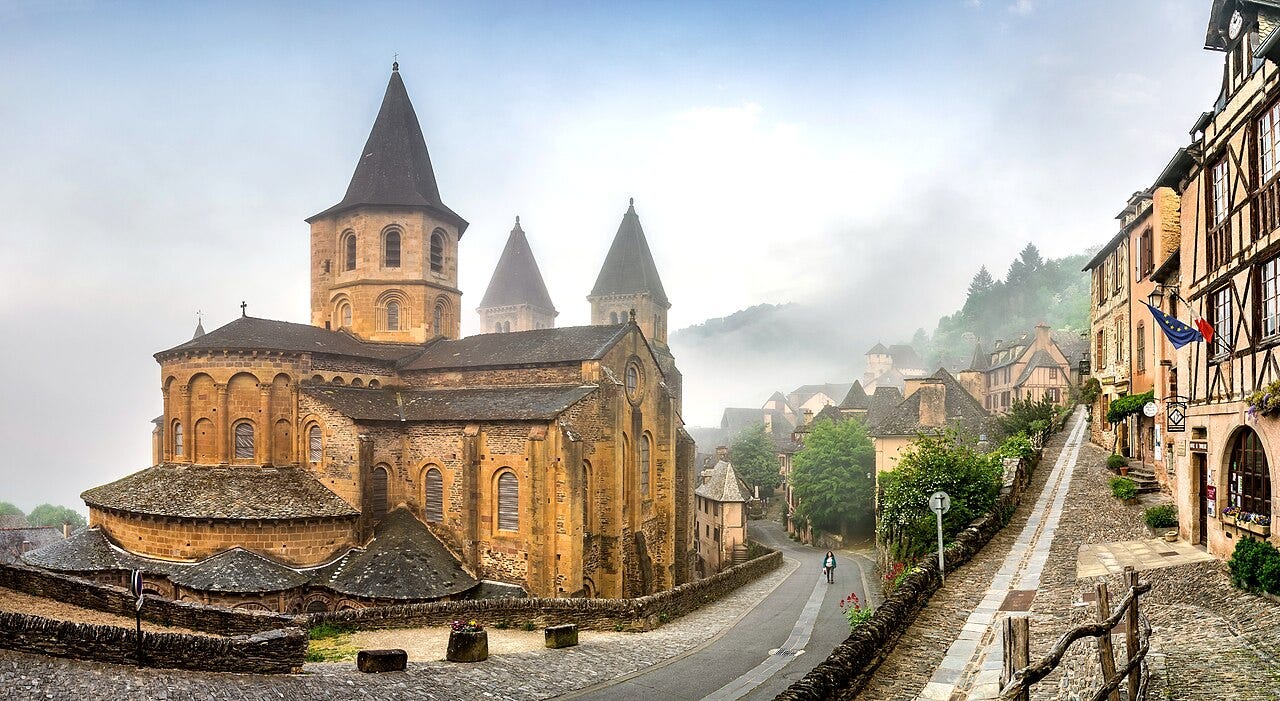
The Romanesque built rest: the only architecture in history whose primary effect is repose, the restless heart arrived. The Gothic built desire, magnificently, and occasionally its punishment — Beauvais drove its choir higher than every rival, and in 1284 matter, which keeps honest records, filed its report. The Renaissance rebuilt Augustine’s mathematics and then misplaced its God: the vanishing point is a tabernacle, and within two centuries of serving the crucified Christ it was serving the window of the absolute monarch.
Between the lines: every one of those ages sinned, and Augustine — who wrote twenty-two books to forbid golden-age fantasies — would say so. But they sinned within the grammar of beauty. Pride built too high; vanity gilded too much. Only our age repudiated the grammar itself. That is the difference between a sinner and an apostate, and it is why the modern city required a new kind of judgment.
The verdict, and the way back
The evidence was there all along, published daily and never read. The mother’s detour with her small child — not there — is the most rigorous architectural criticism in circulation. The songbirds abandoning the rationalized core. The cortisol rising before the blank façade. The price premium on every surviving fragment of old fabric, where housing costs now function as a tax on the perception of beauty. The market has spoken with brutal Augustinian clarity: people pay fortunes to live inside ordered love, because the soul knows what the planning code denies.
What’s next is not utopia — Augustine spent his life burying utopias. It is the reordering of loves, and then the work ordered love performs. Repeal the codes that outlawed the walkable street; the tradition knows how to build, and what it lacks is permission. Patrons matter most: cathedrals were not designed into existence but loved into existence, and your ledger is a confession too. And parents hold the longest lever — take the child to the beautiful building until her nervous system learns what her culture forgot, because a generation that expects beauty will demand it, and a generation that demands it will build it.
The bottom line: a civilization gets the skyline of its loves — and ours has confessed in glass and concrete to loving nothing it was willing to carve. But late, as Augustine knew better than anyone, is not never. It is the first word of every conversion worth recording.